
Trace analysis of glyphosate and AMPA with IC
40 min
en
// Environmental
Dr. Andrea Wille from Metrohm International Headquarters describes how glyphosate and its metabolite AMPA (Aminomethanphosphonic acid) can be analyzed by IC with amperometric detection.
A reliable and cost-effective alternative

Usually, glyphosate and its metabolite AMPA are determined by High-Performance Liquid Chromatography (HPLC) with post-column derivatization and subsequent fluorescence detection (EPA Method 547), or alternatively by ion chromatography coupled with a mass-selective detector.
The following blog article outlines the determination of glyphosate and AMPA in drinking water in the low µg/L range using ion chromatography with pulsed amperometric detection (flexIPAD). This technique proved to be a reliable and, compared with HPLC, inexpensive method for determining the glyphosate and AMPA content in water and foodstuffs.
Glyphosate and AMPA determination with IC
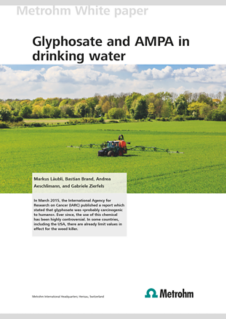
This white paper outlines glyphosate determination and that of its primary metabolite AMPA in drinking water using IC with pulsed amperometric detection (flexIPAD) in the low µg/L range. Compared to HPLC analysis with a mass-selective detector, it is a very cost-effective method for determining the glyphosate and AMPA content in water and foodstuffs. With a detection limit at approx. 1 µg/L, compliance with limit values for glyphosate can be monitored in the USA, Canada, and Australia, among others.