Часто задаваемые вопросы – Титрование по Карлу Фишеру
В списке часто задаваемых вопросов Вы найдете информацию, относящуюся ко всем областям волюмометрического и кулонометрического титрования по методу Карла Фишера.
Installation
Rinse the tubing using the Preparation/«Prep» command before the first measurement if the system has not been used overnight or for even longer periods.
The titrant can change over time in the plastic tubing, which will falsify your results. In addition, the «Prep» procedure removes any air bubbles that may be present in the tubing.
The balance should have a minimum resolution of 0.1 mg.
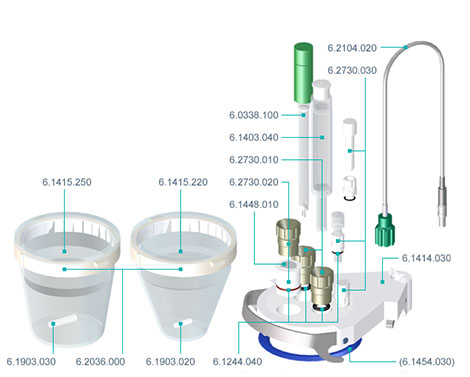
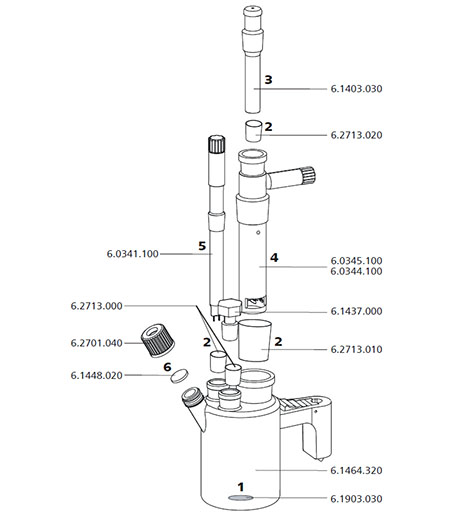
Volumetric Karl Fischer Titration cell:
Coulometric Karl Fischer Titration cell:
Dosing and Exchange Units require regular checks and must be disassembled from time to time and cleaned if necessary. You will find a detailed description in the corresponding manuals.
The solvent keeps flowing into the titration vessel after the addition, without the «addition» key being pressed.
Set the solvent bottle up in such a way that the fluid level in the bottle is lower than in the titration vessel.
Solvent is added simultaneously during aspiration.
The drying tube in the titration vessel is blocked:
- Enlarge the hole on the drying tube cover to at least 2 mm
- Refill the drying tube, do not pack too tightly, possibly remove some of the molecular sieve.
The pump conveys no fluid.
Press the «addition»/«aspiration» key more strongly.
- In most cases the bottle attachments are not screwed tightly enough to the reagent and waste bottles
- Check all connections for leak-tightness
- Check whether the 803 Ti Stand is set up correctly
It is difficult to make a general statement concerning how often the molecular sieve should be replaced, because this is dependent on the humidity in the laboratory. Our experience has shown us that replacement every six weeks is appropriate in the presence of medium humidity. An increase in drift indicates that the leak-tightness of the cell should be inspected and that the molecular sieve should possibly be replaced.
Tip: Write the date on which you have last replaced the molecular sieve on the glass of the drying tube. In this way, you will always know when the next replacement is due.
If a titrator with Dosing Unit is not used for several days, then it is best to empty the Dosing Unit with the «Empty» command. In this way, you will avoid the formation of crystals in the Dosing Unit, the tubing, and the buret tip (antidiffusion valve).
If work is being done with an Exchange Unit, then you should immerse the buret tip in methanol in order to avoid crystallization. To accomplish this, you can either fill the storage vessel with methanol or continue to leave the buret tip in the closed cell filled with working medium, where it is immersed in the working fluid.
The Exchange Unit, the tubing, and the buret tip should all first visually inspected for crystals before the system is returned to operation. If crystals are present, then the tubing should be flushed with methanol or ethanol and then dried afterwards.
If no crystals are visible, then a small amount of reagent should nevertheless be dosed in order to check whether crystals have formed in the flat stopcock of the Exchange Unit. If reagent escapes from the flat stopcock, then the Exchange Unit must be disassembled and cleaned (see manual for the Exchange Unit).
Afterwards, flush the Exchange Unit by means of the Preparation/«Prep» command in order to make it ready for operation again.
Titer determination
|
Sample size for 5 mL buret |
||
Type of standard |
Titrant 1 |
Titrant 2 |
Titrant 5 |
Water standard 10 mg/g |
0.05–0.45 g |
0.1–0.9 g |
0.25–2.25 g |
Na tartrate 156.6 mg/g |
|
0.006–0.057 g |
0.03–0.27 g |
Water 1000 mg/g |
– |
– |
~ 0.02 g |
Water |
– |
– |
~ 20 µL |
|
Sample size for 10 mL buret |
||
Type of standard |
Titrant 1 |
Titrant 2 |
Titrant 5 |
Water standard 10 mg/g |
0.1–0.9 g |
0.2–1.8 g |
0.5–4.5 g |
Na tartrate 156.6 mg/g |
0.02–0.057 g |
0.013–0.115 g |
0.03–0.287 g |
Water 1000 mg/g |
– |
~ 0.015 g |
~ 0.025 g |
Water |
– |
~ 15 µL |
~ 25 µL |
|
Sample size for 20 mL buret |
||
Type of standard |
Titrant 1 |
Titrant 2 |
Titrant 5 |
Water standard 10 mg/g |
0.2–1.8 g |
0.4–3.6 g |
1–9 g |
Na tartrate 156.6 mg/g |
0.02–0.175 g |
0.026–0.23 g |
0.065–0.58 g |
Water 1000 mg/g |
– |
0.02–0.035 g |
0.02–0.09 g |
Water |
– |
15–35 µL |
15–90 µL |
It is also possible to determine the titer with water. It should be noted in this connection that very small volumes have to be used. The handling takes a bit of getting used to in the beginning and requires a great deal of practice.
The detailed procedural method can be seen in the videos here.
It is difficult to make a general statement. The frequency of titer determination depends on a variety of different factors:
- leak-tightness of the titration system
- selection of the titrant
- humidity in the laboratory
- changes in room temperature
- requirements regarding exactness of the result
In principle, we recommend that titer determination should be carried out daily in the presence of high requirements concerning exactness. If no relevant changes are found, then the frequency can be reset to weekly. It should be noted that in general the titer of one-component reagents drops faster than that of two-component reagents.
The disodium tartrate dihydrate dissolves incompletely when several determinations are carried out in the same working medium because of the limited capacity of methanol to dissolve disodium tartrate dihydrate.
We recommend that you replace the working medium at shorter intervals.
The disodium tartrate dihydrate has probably not dissolved completely. The extraction time should be increased in order to prevent this.
In addition, care should be taken to ensure that the sample does not remain on the side of the vessel or on the electrode.
An increasing titer may be traced back to the limited capacity of the methanol to dissolve disodium tartrate dihydrate. We recommend that you replace the working medium at shorter intervals.
Another reason may be that the sample size selected was not optimal.
Leading reagent manufacturers offer certified water standards for titer determination. We recommend the use of certified standards. They are simpler to handle, because larger sample volumes can be added here than with titer determination using distilled water.
Standard solutions can be obtained with the water contents 10.0 ±0.1 mg/g and 5 ±0.2 mg/mL, although the latter is not certified.
The possibility also exists of carrying out the titer determination with distilled water or with disodium tartrate dihydrate.
Sample handling
A. It is usually sufficient to clean the platinum pins of the electrode with a soft paper tissue. However, you should take care to ensure while doing so that the platinum pins are not pressed together. They should always be parallel to one another.
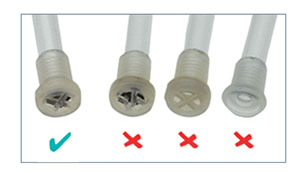
B. In volumetric KF titration, the antidiffusion valve on the buret tip should be checked.
See the photo: good buret tip in comparison with defective buret tips

C. Check if you are using the recommended parameters:
Volumetric KF titration
|
Ethanol-containing reagents |
Methanol-containing reagents |
Polarization current Ipol |
20 µA |
50 µA |
Endpoint indication at |
500 mV |
250 mV |
Coulometric KF titration
Ethanol-containing reagents |
Methanol-containing reagents |
|
Polarization current Ipol |
10 µA |
10 µA |
Endpoint indication at |
20 mV |
50 mV |
D. A further cause of overtitration could be that the initial solution no longer contains sufficient methanol or ethanol. In such a case it is worthwhile to renew the cell solution and/or to check whether too much solubility promoter has been used. Read for more details in the following FAQ: «How often must the KF working medium be replaced?».
See table: Solubility promoters for volumetric and for coulometric titration
Volumetric KF titration
Solvent |
Percentage |
Samples |
Formamide |
max. 50% |
Sugar samples, salts |
Chloroform |
max. 70% |
Oil, grease |
Long-chain alcohols |
max. 50% |
Oil, grease |
Xylene, toluene |
max. 70% |
Crude oils with tars |
Coulometric KF titration
Solvent |
Percentage |
Samples |
Formamide* |
max. 20% |
Sugar samples, salts |
Chloroform** |
max. 30% |
Oil, grease |
Long-chain alcohols** |
max. 30% |
Oil, grease |
Xylene, toluene** |
max. 30% |
Crude oils with tars |
* Only with generator electrode without diaphragm.
** Use generator electrode with diaphragm if the amount of solubility promoter is higher than 10%.
Additional measures:
E. Increasing the stirring rate.
F. Check whether the platinum pins of the electrode are immersed completely in the cell solution.
G. Check whether the correct reagents were combined: if the titrant of the two-component reagent is used with methanol, the KF reaction cannot take place, because no SO2 is available for the reaction. (Only volumetric KF titration.)
Results may be too high for the following reasons:
Cause |
Remedy |
Side reaction |
Read for more details in the following FAQ: «How to recognize a side reaction? How to prevent side reactions?» |
The sample is hygroscopic |
Here we recommend optimizing the sampling and the sample storage as well as working speedily during the determination. |
The sample is inhomogeneous |
|
Overtitration |
Read for more details in the following FAQ: «Overtitration took place, i.e., the titrated solution is dark yellow to brown instead of light yellow. How to prevent this?» |
Only for volumetric KF titration: |
|
The titer has changed since the last determination |
Redetermine the titer. |
Air bubbles in the tubing |
Flush the tubing system using the Preparation/«Prep» command. |
Non-leak-tight tubing system |
|
The following causes can be responsible for poor reproducibility:
Cause |
Remedy |
Sample amount too small (weighing error) |
Increase the sample amount. If samples with high water contents are analyzed via volumetric Karl Fischer titration it may be better to use a Dosing or Exchange Unit with a greater buret volume in order to avoid filling of the Dosing or Exchange Unit during the titration. |
Insufficient use of titrant (volumetric KF titration) |
Increase the sample size and select an Exchange or Dosing Unit so that at least 10% of the buret volume is used, or use a titrant with a lower titer. |
Inhomogeneous sample |
|
Sample does not dissolve completely |
Add smaller amounts of sample or use solubility promoters. |
Sample remains on the wall of the vessel |
Slight shaking of the titration vessel. |
Overtitration |
Read for more details in the following FAQ: «Overtitration took place, i.e., the titrated solution is dark yellow to brown instead of light yellow. How to prevent this?» |
In the case of two-component-reagents, the water capacity is limited by the amount of SO2 and buffer in the solvent. Decreasing pH values and decreasing SO2 concentrations result in a drop in titration speed.
Reagent manufacturers have published the following guideline: In the case of cell solutions with 20 to 25 mL of solvent, the cell solution should be replaced after approximately 30 mL of titrant has been used.
- Use of so-called K-reagents with samples that contain ketones and aldehydes.
- Methanol-free reagents when the sample reacts with the methanol of the reagent.
- When the sample causes a pH shift to the acid range, buffering can be accomplished with solvent and imadazole.
- When the sample causes a pH shift to the alkali range, adding approx. 5 g salicylic acid or benzoic acid to the working medium helps to adjust the optimum pH range for the KF reaction.
- To suppress the side reaction, peroxides can be titrated under cold conditions, e.g., at –20 °C to –60 °C (set Ipol to 5 µA).
- If the sample (e.g., motor oil) contains various substances that react directly with the KF reagent, then a KF oven will be of help.
You will find more detailed information as to which procedure is suitable for which sample in the Metrohm KF monograph.
If the drift during pretitration (conditioning) is too high after the addition of fresh working medium, then this is a sign that the titration cell is not protected sufficiently against humidity. Replace the molecular sieve and the septum, also check whether all of the O-rings/PTFE sleeves are in proper working condition (damage, cracking).
If the drift is too high after the completion of a sample titration, then this is usually because of other reasons:
- The sample has not dissolved completely during titration and continues to release water. An increase of the extraction time or other sample pretreatment steps are recommended. Read for more details in the following FAQ: «What to do to improve the release of water?»
- The sample reacts with the KF reagent, a side reaction takes place. Depending on the type of the side reaction, this can be suppressed not only with special reagents, but also by means of appropriate titration methods (KF oven method, titration in the cold, or external extraction).
- The sample has shifted the pH value. Read for more details in the following FAQ: «How can I prevent side reactions or pH value shifts?»
Volumetric KF titration
The sample size depends on the water content of the sample. In principle, the sample size should be selected in such a way that the titrant consumption lies between 10% and 90% of the buret volume. This means that if work is being done with a 10 mL Exchange or Dosing Unit, the consumption level of the titrant should be between 1 and 9 mL.
In addition, you should take care to ensure that the sample weight selected is not too low. The weighing error will be too great on the one hand, while on the other the sample will no longer be representative. In cases of high water content, it may be better to use a Dosing or Exchange Unit with a greater buret volume in order to avoid filling the Exchange Unit during the titration.
If the sample does not dissolve completely in the working medium, then the sample size has perhaps been selected too high and exceeds the dissolving capacity of the working medium. This can be remedied through the use of a smaller Dosing/Exchange Unit or a titrant with a lower water equivalent, e.g., 2 mg/mL or 1 mg/mL. Despite the lower initial weight, the titrant consumption will then achieve 10 to 90% of the buret volume.
As a general rule: When the titrant consumption is low, you should work with a lower titer (e.g., Titrant 1, Titrant 2), and with a high titer when titrant consumption is a high (Titrant 5).
Table: Recommended sample size
Sample |
Approximate sample size [g] for 5 mL buret |
||
Expected water content |
Titrant 1 |
Titrant 2 |
Titrant 5 |
0.5% |
0.1–0.9 |
0.2–1.8 |
0.5–4.5 |
1.0% |
0.05–0.45 |
0.1–0.9 |
0.25–2.25 |
5.0% |
– |
0.02–0.18 |
0.05–0.45 |
10.0% |
– |
– |
0.025–0.225 |
25.0% |
– |
– |
– |
50.0% |
– |
– |
– |
Sample |
Approximate sample size [g] for 10 mL buret |
||
Expected water content |
Titrant 1 |
Titrant 2 |
Titrant 5 |
0.5% |
0.2–1.8 |
0.4–3.6 |
– |
1.0% |
0.1–0.9 |
0.2–1.8 |
0.5–4.5 |
5.0% |
0.02–0.18 |
0.4–0.36 |
0.1–0.9 |
10.0% |
– |
0.02–0.18 |
0.05–0.45 |
25.0% |
– |
– |
0.02–0.18 |
50.0% |
– |
– |
0.02–0.09 |
Sample |
Approximate sample size [g] for 20 mL buret |
||
Expected water content |
Titrant 1 |
Titrant 2 |
Titrant 5 |
0.5% |
0.4–3.6 |
– |
– |
1.0% |
0.2–1.8 |
0.4–3.6 |
– |
5.0% |
0.04–0.36 |
0.8–0.72 |
0.2–1.8 |
10.0% |
0.02–0.18 |
0.04–0.36 |
0.1–0.9 |
25.0% |
– |
0.016–0.144 |
0.04–0.36 |
50.0% |
– |
– |
0.02–0.18 |
Coulometric KF titration
The sample size depends on the water content and should be small in order to allow you to titrate as many samples as possible in the same reagent and to keep the determination time short. However, ensure that the sample contains at least 50 µg of H2O.
The following table provides an indication of the sample size.
Water content of the sample |
Sample size |
H2O, to be determined (water content) |
10000 ppm = 1% |
10 mg–100 mg |
100 µg–1000 µg |
1000 ppm = 0.1% |
100 mg–1 g |
100 µg–1000 µg |
100 ppm = 0.01% |
1 g |
100 µg |
10 ppm = 0.001% |
5 g |
50 µg |
In cases of samples with low solubility, one of the following procedures is recommended:
A) Use of a solubility promoter
Volumetric KF titration
Solvent |
Percentage |
Samples |
Formamide |
max. 50% |
Sugar samples, salts |
Chloroform |
max. 70% |
Oil, grease |
Long-chain alcohols |
max. 50% |
Oil, grease |
Xylene, toluene |
max. 70% |
Crude oils with tars |
Coulometric KF titration
Solvent |
Percentage |
Samples |
Formamide* |
max. 20% |
Sugar samples, salts |
Chloroform** |
max. 30% |
Oil, grease |
Long-chain alcohols** |
max. 30% |
Oil, grease |
Xylene, toluene** |
max. 30% |
Crude oils with tars |
* Only with generator electrode without diaphragm.
** Use generator electrode with diaphragm if the amount of solubility promoter is higher than 10%.
B) Titration at a higher temperature
Temperature |
Samples
|
40 °C / 50 °C |
Vegetable samples, salts, fat-containing samples, food samples |
C) Mechanical pretreatment
- Homogenizer
- Mortar
- Lab mill (cooled)
These procedures can also be combined with each other. Detailed information as to which procedure is suitable for which sample can be found in the Metrohm KF monograph.
- A side reaction is taking place. Read for more details in the following FAQs: «How to recognize a side reaction?», «How to prevent side reactions?»
- The cell is not leak-tight. In this case carry out the following measures: replace molecular sieve, O-rings/PTFE sleeves, and septum.
- There are deposits on the indicator electrode. Read for more details in the following Installation FAQ: «How to clean the indicator electrode?»
The following characteristics indicate the presence of a side reaction:
- High drift after the titration has been completed, slow endpoint recognition, or no endpoint found at all.
- The water contents determined are not independent of the sample weight.
- The results are too high or too low (depending on the type of side reaction).
- The water recovery rate found when spiking samples is not within 100 ±3%.
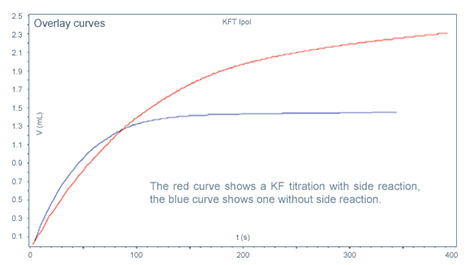
See Figure 1: Curve for a titration with side reaction.

The red curve shows the typical curve shape for a KF titration with side reaction. The curve exhibits a continuous slight rise after the water has been titrated, meaning that there is a steady consumption of reagent to be observed as a result of the side reaction, which leads to incorrect results.
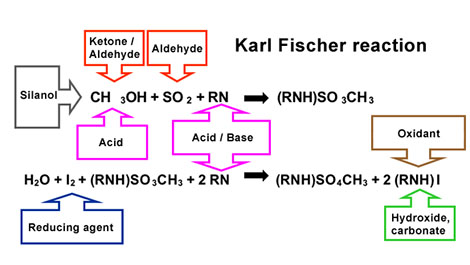
See Figure 2: Substances that can cause side reactions.

Results may be too low for the following reasons:
Cause |
Remedy |
Side reaction |
Read for more details in the following FAQ: «How to recognize a side reaction?», «How to prevent side reactions?» |
The sample is inhomogeneous |
|
The sample dissolves incompletely |
Read for more details in the following FAQ: «What can I do to improve the release of water?» |
The pretreatment of the sample is not optimal. |
Read for more details in the following FAQ: «What to do to improve the release of water?» |
Titer is incorrect (volumetric KF titration) |
Redetermine the titer with certified standards. |
Titration stops too soon |
Reduce Stop Drift or work with a relative Start Drift. |
The sample gives off water even during sample preparation |
Here we recommend optimizing the sampling and sample storage, as well as rapid working during the determination sequence. |
Trend within the results
One reason for decreasing water contents in a series may be that the solvent is exhausted and must be replaced. Decreasing water contents within a series can also occur with samples which give off water during sample handling. Here we recommend optimizing the sampling and sample storage, as well as rapid working during the determination sequence.
A further possible reason for apparently decreasing water contents within a series in volumetric Karl Fischer titration is that the buret has not been prepared. The titrant in the cylinder and in the tubing is exposed to humidity, which can result in increased titrant consumption at the beginning of a series.
Increasing water contents within a series can occur with hygroscopic samples. Here we recommend optimizing the sampling and sample storage, as well as rapid working during the determination sequence.
Tip: You can recognize very quickly whether your sample is either releasing water, is hygroscopic, or unproblematic by determining the water content of the sample immediately and then leaving the sample to stand in a beaker in the laboratory air and determining the water content again after 10, 30, and 60 minutes.
In the case of two-component-reagents, the water capacity is limited by the amount of SO2 and buffer in the solvent. Decreasing pH values and decreasing SO2 concentrations result in a drop in titration speed. Reagent manufacturers have published the following guideline: The cell solution should be replaced after approximately 30 mL of titrant have been used in the case of cell solutions with 20 to 25 mL of solvent.
One-component reagents have no limiting water capacity, because SO2 and buffer are added with the titrant. Care must nevertheless be taken to ensure that the methanol content does not drop below 25%, because otherwise the endpoint will be shifted.
Info: The water capacity indicates how much water can be determined in a particular titration solution.
Coulometric KF reagents contain iodide instead of iodine. Additional components are sulfur dioxide and imidazole, which are dissolved in methanol. Generally, coulometric KF reagents have a water capacity of 1000 mg H2O per 100 mL. Depending on the type of reagent the water capacity can also be lower.
Reagents
For volumetric KF titration, a general distinction is made between one-component and two-component reagents:
One-component reagent |
Two-component reagent |
||
Working medium |
Titrant |
Working medium |
Titrant |
Methanol |
Alcohol*/DEGEE** |
Iodine |
Alcohol* |
Advantages:
|
Advantages:
|
||
Disadvantages:
|
Disadvantages:
|
||
* Methanol or ethanol
** Diethylene glycol monoethyl ether
Reagents for coulometric KF titration contain iodide. The suitable reagent needs to be selected in accordance with the type of generator electrode (with or without diaphragm). For more information on the different types of coulometric KF reagents please refer to the manufacturers of KF reagents.
The following manufacturers offer KF reagents:
Honeywell:
www.hydranal-honeywell.com
Sigma-Aldrich:
http://www.sigmaaldrich.com/analytical-chromatography/titration/karl-fischer-titration.html
Validation
GLP (Good Laboratory Practice) requires, among other things, periodic checking of the analytical instruments for their reproducibility and correctness on the basis of Standard Operating Procedures (SOPs). It is recommended that the instruments are qualified on a regular basis
For more information please contact us.